Seeing Sound: Inside the Minds of Producers Who Experience Music as Color
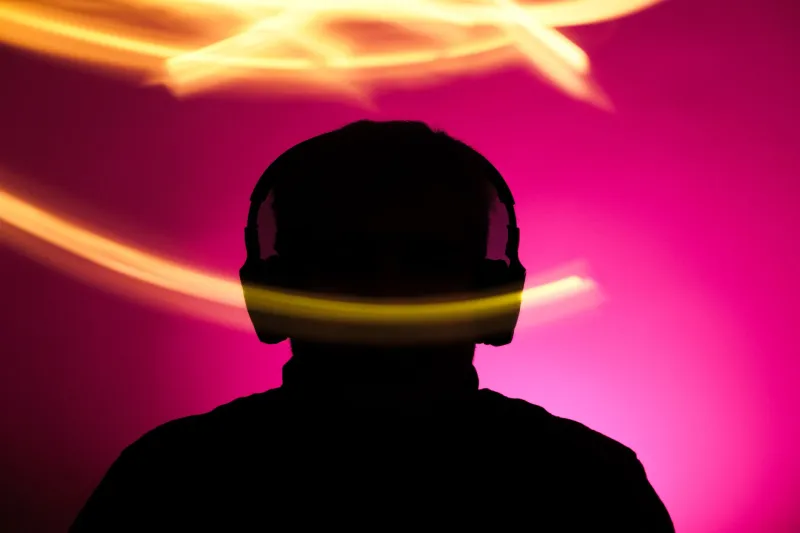
Imagine sitting down at your DAW and watching your kick drum flash a deep cobalt blue every time it hits. The synth pad you just loaded? It bleeds warm amber across your field of vision. The hi-hat rolls in as a sharp, electric white. For most of us, that sounds like something out of a fever dream. For a surprising number of working electronic producers, it's just Tuesday.
This is synesthesia — a real, documented neurological condition where stimulation of one sense automatically and involuntarily triggers an experience in another. In the music world, the most common form is chromesthesia, where sounds produce visual color experiences. And in electronic production specifically, where artists are constantly sculpting frequencies from scratch, the implications are genuinely wild.
What's Actually Happening in the Brain
Neuroscientists have been studying synesthesia for decades, and while there's still a lot to unpack, the leading theory points to cross-activation between adjacent regions in the brain. The areas responsible for processing sound and color perception sit relatively close to each other in the cortex, and in synesthetes, those regions appear to communicate in ways they don't in neurotypical brains.
Research from institutions like the Salk Institute and University of Edinburgh has shown that synesthesia is hereditary, shows up in brain imaging as measurable cross-sensory activity, and is entirely consistent — meaning a synesthetic producer who hears the note C as red will always hear it as red, not just sometimes. It's not imagination. It's wiring.
Roughly 4% of the population is estimated to have some form of synesthesia, but the condition appears to be significantly more prevalent among creative types — musicians, painters, and writers show up in studies at rates far higher than the general population. Whether that's because creative people are more attuned to their own perceptual experiences, or because synesthesia genuinely fuels creative output, is still being debated.
In the Studio: A Different Kind of Palette
For producers who experience chromesthesia, the creative process takes on an entirely different dimension. Instead of relying purely on waveform displays, spectral analyzers, and reference tracks, they're working with a built-in visual feedback system that no plugin can replicate.
Take Chicago-based electronic artist Mara Soleil, who has been open about her synesthetic experience in interviews and on social media. She's described her workflow as "mixing colors as much as mixing frequencies." When a track feels muddy in the low-mids, she sees it as a murky brownish-gray smear, and she'll EQ until the visual clears up. When a drop hits the way she wants it to, she says it "goes white" — a full wash of brightness that tells her the energy is right before her ears even consciously register it.
That kind of dual-channel feedback is hard to quantify, but it's not hard to understand why it might be useful. Electronic producers spend enormous amounts of time and money on visual metering tools, spectrum analyzers, and LUFS meters precisely because translating sound into something you can see helps with decision-making. Synesthetic producers are doing that automatically, for free, in real time.
Does It Actually Give You an Edge?
Here's where it gets complicated. Synesthesia isn't universally an advantage. Some producers who experience it describe moments where the visual noise becomes distracting — especially when working in overstimulating environments or on particularly dense arrangements. A wall of sound that produces a chaotic visual field can make it genuinely harder to focus.
There's also the question of whether the cross-sensory experience translates into better music, or just different music. Researchers haven't conclusively proven that synesthetic musicians produce objectively superior work. What they have found is that synesthetes often demonstrate heightened pattern recognition, stronger emotional memory for musical passages, and a tendency toward more distinctive sonic identities — all of which are qualities that serve artists well in a crowded market.
Producer and sound designer Deven Hargrove, based out of Atlanta, has talked about how his synesthesia influenced his signature approach to layering textures. "I'm not just stacking sounds," he's said. "I'm building a visual world. Every element has to look right together before I'm satisfied." That kind of holistic, multi-sensory aesthetic thinking tends to produce cohesive, immersive records — the kind that keep listeners locked in from the first bar to the last.
What Non-Synesthetic Producers Can Learn From This
Here's the thing: you don't have to have synesthesia to start thinking about your music visually. The cross-sensory framework these producers use can be approximated — or at least inspired — by the rest of us.
A lot of working producers already do this intuitively. Describing a snare as "sharp" or a pad as "warm" is synesthetic-adjacent language. Mixing engineers talk about sounds having "weight" or "space." These are tactile and spatial metaphors for purely auditory experiences, and they work because they give us a richer vocabulary for something that's otherwise hard to articulate.
Some producers have even started deliberately building visual references into their sessions — pulling up color palettes or mood boards before they start working, or assigning colors to different frequency ranges as a loose guide. It's not the same as genuine synesthesia, but it taps into the same underlying idea: that richer sensory framing leads to more intentional creative decisions.
The Frequency Meets the Spectrum
At Rayez Music, we talk a lot about feeling every frequency — and synesthesia is maybe the most literal version of that idea imaginable. These producers aren't just hearing their music. They're experiencing it across multiple senses simultaneously, and that depth of perception shows up in the work.
Whether synesthesia is a superpower, a quirk, or just a different way of being human, it's a reminder that creativity doesn't look the same for everyone. The artists who've learned to lean into what makes their perception unusual are often the ones building the most distinctive sonic worlds — the kind of tracks that make you feel like you're inside something, not just listening to it.
Next time a track makes you close your eyes and see something behind your eyelids, maybe that's not just your imagination running wild. Maybe you're picking up on exactly what the producer intended you to feel.