Blackout Sessions: The Dark Room Technique That's Producing Some of Electronic Music's Most Intense Sounds
The Studio Goes Dark
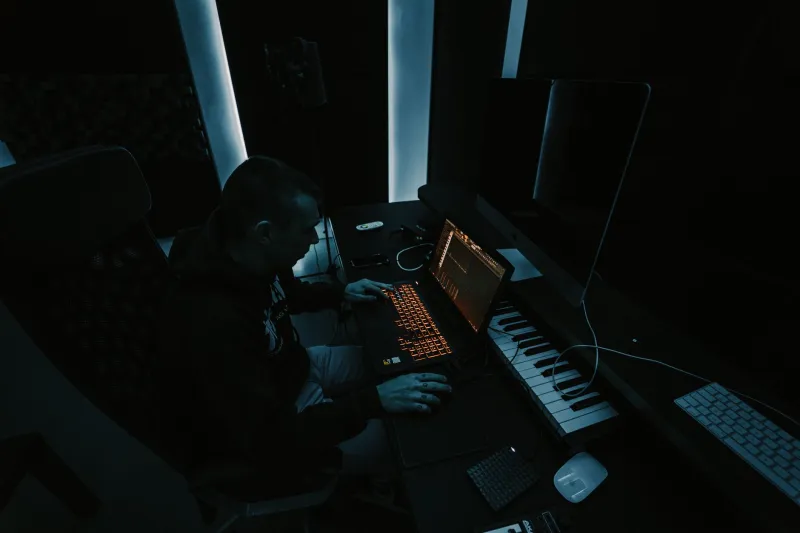
Picture this: it's 11 PM, and a producer in a rented studio space in East Nashville has taped blackout curtains over every window, turned off every monitor light, covered every blinking LED on every piece of gear, and is now sitting in absolute darkness with a pair of headphones clamped over his ears. No visual reference. No phone. No clock. Just sound.
This isn't a power outage. This is a choice.
For a small but growing cluster of electronic artists, total sensory reduction has become a deliberate production method — a way of stripping away the noise of the modern studio environment to access something rawer and more instinctive in the music-making process. The results, judging by the tracks emerging from these pitch-black sessions, are hard to argue with.
Why the Eyes Are the Enemy
Here's something most producers don't think about consciously: visual information dominates human perception. Neuroscientists estimate that roughly 80 percent of our sensory processing is dedicated to sight. When your eyes are open and busy — scanning waveforms, checking plugin interfaces, glancing at a phone notification — your brain is allocating enormous resources to vision, leaving the remaining senses to fight over the scraps.
Close your eyes, cut the light, and something shifts. Auditory processing sharpens. Sounds you were technically hearing but not really registering suddenly become vivid. Subtle frequency relationships, spatial qualities in a reverb tail, the way a hi-hat sits inside a mix — these details surface when your brain isn't competing with a screen for attention.
This isn't mysticism. It's neuroscience. Research into sensory substitution and cross-modal plasticity has documented how the brain reassigns processing resources when one sense is reduced. Blind musicians demonstrating superior pitch discrimination and tonal memory is one of the more well-documented examples of this phenomenon.
For electronic producers working in a genre where frequency relationships and spatial design are fundamental craft elements, that sharpened auditory attention is genuinely valuable.
The Producers Doing It
Amara Solís, a Brooklyn-based producer who makes textured electronic music somewhere between ambient and club-ready, started experimenting with darkness sessions after hitting a creative plateau. "I was over-relying on my eyes," she says. "I'd look at a waveform and make decisions based on what I saw instead of what I heard. That's completely backwards."
Her first full darkness session lasted about forty minutes before she gave up. The second lasted two hours and produced a track she describes as unlike anything she'd made before. "There was this weird intimacy to it. Like I was inside the sound rather than observing it."
That language — inside the sound — comes up repeatedly when producers describe these sessions. It points to something real about how spatial perception works in the absence of visual anchoring. Without a physical environment to orient yourself in, the sonic environment your headphones or speakers create becomes the primary space your brain inhabits.
Jordan Fitch, a Portland-based producer who makes dark, industrial-influenced techno, takes the practice further. He works in total darkness for the first two hours of every significant session, then transitions to his normal lit studio setup for technical refinement. "The dark session is where I find what the track is actually about," he explains. "The lit session is where I clean it up. They're doing completely different jobs."
Building the Blackout Studio
For producers curious enough to try this, the setup is surprisingly low-tech. The basics:
Start with physical darkness. Blackout curtains, electrical tape over LED indicators, a dark towel over the computer monitor. The goal is genuine darkness, not just dim lighting — your eyes need to fully disengage.
Silence the environment as much as possible. This might mean working late at night, using noise-canceling headphones, or both. Ambient noise pulls attention outward in ways that compete with deep listening.
Remove the clock. Time perception shifts dramatically in darkness and silence, and that's actually part of the point. The usual sense of "I've been working for two hours and I should have something by now" dissolves. Sessions become more instinctive and less productivity-oriented.
Finally, don't try to accomplish too much. Most producers who use this method treat it as an exploratory phase — idea generation, emotional direction-finding, discovering what a track wants to be — rather than a full production workflow. The technical work comes later, with the lights on.
The Unexpected Creative Payoff
Beyond the neuroscience, there's something else happening in these sessions that's harder to quantify. Working in darkness disrupts habitual patterns. The familiar visual cues of a studio — the plugin interface you always reach for first, the template you load out of habit — disappear. You're left with sound and instinct.
Solís describes finishing a track from a darkness session and listening back in normal conditions for the first time. "I'd made decisions I never would have made with my eyes open. Some of them were wrong and I fixed them. But a lot of them were better than my usual choices because they were purely sonic. No visual logic. Just ears."
Fitch puts it more bluntly: "The darkness gets your ego out of the room. You stop performing for yourself and just make something."
For a genre built on the premise that sound can create complete worlds — that a club track at the right volume in the right room can dissolve the boundary between listener and music — the idea of eliminating the visual entirely to access something purer feels less like a gimmick and more like a logical extension of what electronic music has always been reaching for.
Sometimes the most radical studio upgrade is a roll of electrical tape and a willingness to sit in the dark.