Sound From Every Direction: How Spatial Audio Is Rewriting the Rules for Electronic Producers
For decades, electronic music lived in stereo. Left channel, right channel, and everything in between — that was the whole game. Producers spent years perfecting the art of the stereo field, learning how to carve out space for a kick drum without burying a synth lead, how to make a wide mix feel full without sounding muddy. It was a craft, and a lot of people got really good at it.
Then spatial audio showed up and quietly started moving the goalposts.
Platforms like Apple Music, Amazon Music HD, and Tidal are now serving up Dolby Atmos mixes to millions of subscribers. Spotify has been rolling out its own immersive audio features. And electronic producers — especially those competing for playlist placement and listener retention — are realizing that a flat stereo mix might not cut it in 2025 the same way it did in 2015.
What Spatial Audio Actually Is (And Isn't)
Let's clear something up first. Spatial audio isn't just a fancy reverb plugin or a wider stereo image. Dolby Atmos, the format most streaming platforms have standardized around, is an object-based audio system. Instead of assigning sounds to fixed channels, producers can place individual elements — a hi-hat, a bass pulse, a vocal chop — at specific points in a three-dimensional space. Height included.
When you're listening through compatible headphones or a properly configured speaker system, the result is genuinely different. Sounds can appear above you, behind you, or anchored dead center in a way that stereo can't replicate. For electronic music specifically, where sound design and texture are often the whole point, that kind of spatial depth opens up a completely different palette.
But here's the thing: most people are experiencing spatial audio through headphones using binaural rendering, which is software translating that 3D object data into something two ears can process. The experience is impressive, but it's not the same as a full Atmos-configured room. That gap matters, and producers are having to think about both scenarios at the same time.
Why Producers Are Paying Attention Now
The push toward spatial audio from streaming platforms is partly a differentiation play — these services need reasons for subscribers to stay and upgrade to higher tiers. But it's also created a real incentive structure for producers. Tracks mixed in Dolby Atmos tend to get featured placement on dedicated spatial audio playlists, which on Apple Music alone can mean significant discovery exposure.
Producers like Kaytranada and Four Tet have already delivered Atmos mixes of recent projects, and the electronic community has taken notice. The conversation in production forums and Discord servers has shifted from "should I bother" to "how do I actually do this without tanking my stereo master in the process."
And that last part is where it gets complicated. Mixing in Atmos requires different tools, a different monitoring setup, and honestly a different way of thinking about arrangement. You're not just placing sounds left to right anymore — you're building an environment.
The Technical Lift Is Real
Getting into spatial audio production isn't cheap or simple. Logic Pro added native Dolby Atmos support a few years back, which brought the barrier down significantly for producers already in the Apple ecosystem. Pro Tools and Nuendo both support Atmos workflows too. But having the software is just the start.
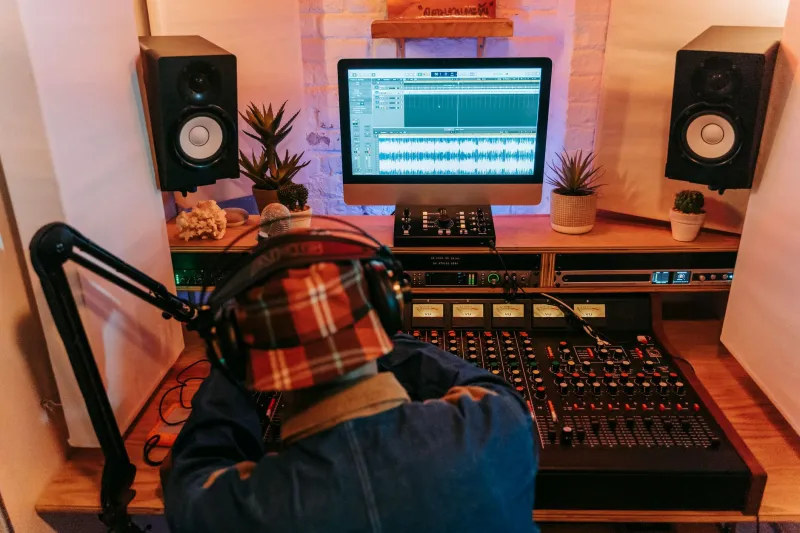
Proper Atmos monitoring requires either a multi-speaker setup — ideally a 7.1.4 configuration — or a pair of binaural headphones with head-tracking capabilities. Most bedroom producers don't have that. What they do have is a decent pair of studio headphones and a plugin like Dolby Atmos Renderer, which lets you simulate the spatial experience well enough to make mixing decisions.
The workflow itself is also more demanding. Every sound in an Atmos mix needs metadata attached to it — is it an object moving through space, or is it part of a fixed bed? How does it behave when the listener turns their head? These aren't questions stereo mixing ever asked.
Producers who've made the jump describe an adjustment period of several months before spatial mixes start sounding intentional rather than just disorienting. The temptation to put everything everywhere is real, and the producers who are doing it well tend to be the ones using restraint — using height and depth selectively rather than treating it like a new effects chain to max out.
What Listeners Actually Need to Hear It
This is the part that doesn't get talked about enough. The majority of music listeners in the US are still hearing everything through earbuds, Bluetooth speakers, or their phone's built-in audio. For those people, a spatial audio mix is going to be downmixed to stereo automatically, and the experience depends entirely on how well that downmix was handled.
A poorly executed Atmos mix can actually sound worse in stereo than a well-crafted stereo master. Phase issues, frequency masking, and level inconsistencies that weren't obvious in 3D can become very obvious when everything collapses to two channels. That's why the best producers working in this space are checking their mixes in both formats before anything goes to distribution.
For listeners who want the full experience, AirPods Pro and AirPods Max with head-tracking enabled are probably the most accessible entry point in the US market. Sony's WH-1000XM5 and select Samsung Galaxy Buds also support spatial audio rendering. Car audio is another growing front — newer vehicles from brands like BMW, Volvo, and select Ford and GM models are shipping with Atmos-compatible speaker configurations.
The Creative Upside Is Hard to Argue With
Beyond the technical headaches, producers who've embraced spatial audio tend to come back saying the same thing: it changed how they hear their own music. When you're forced to think about where a sound lives in three-dimensional space, you start making different decisions about what sounds you're using in the first place.
Texture, movement, and depth become primary tools rather than finishing touches. A pad that would've just sat in the mid-range of a stereo mix can wrap around a listener's shoulders in Atmos. A percussion element can feel like it's coming from a different room. For a genre built on the idea of creating immersive sonic experiences — whether in a club, at a festival, or through headphones at 2 AM — that's not a gimmick. That's an extension of what electronic music has always been trying to do.
The frequency wars are real. And the producers winning them aren't just the ones with the best sounds — they're the ones who figured out how to place those sounds in space.